
The ‘AI in Agencies’ Spark Report for Autumn/Winter 2026 has found that while 90% of agency staff use AI at work, few are turning AI productivity gains into commercial return
Only 9% of agencies have redesigned a workflow end to end, and just 6% have enabled a new AI revenue model
Unless pricing models change, clients will benefit from efficiencies, but agencies themselves will not, the report warns
Meanwhile, 44% of agencies have an AI policy that nobody checks. More than half (55%) said they have no formal position on telling clients how AI is used in their work.
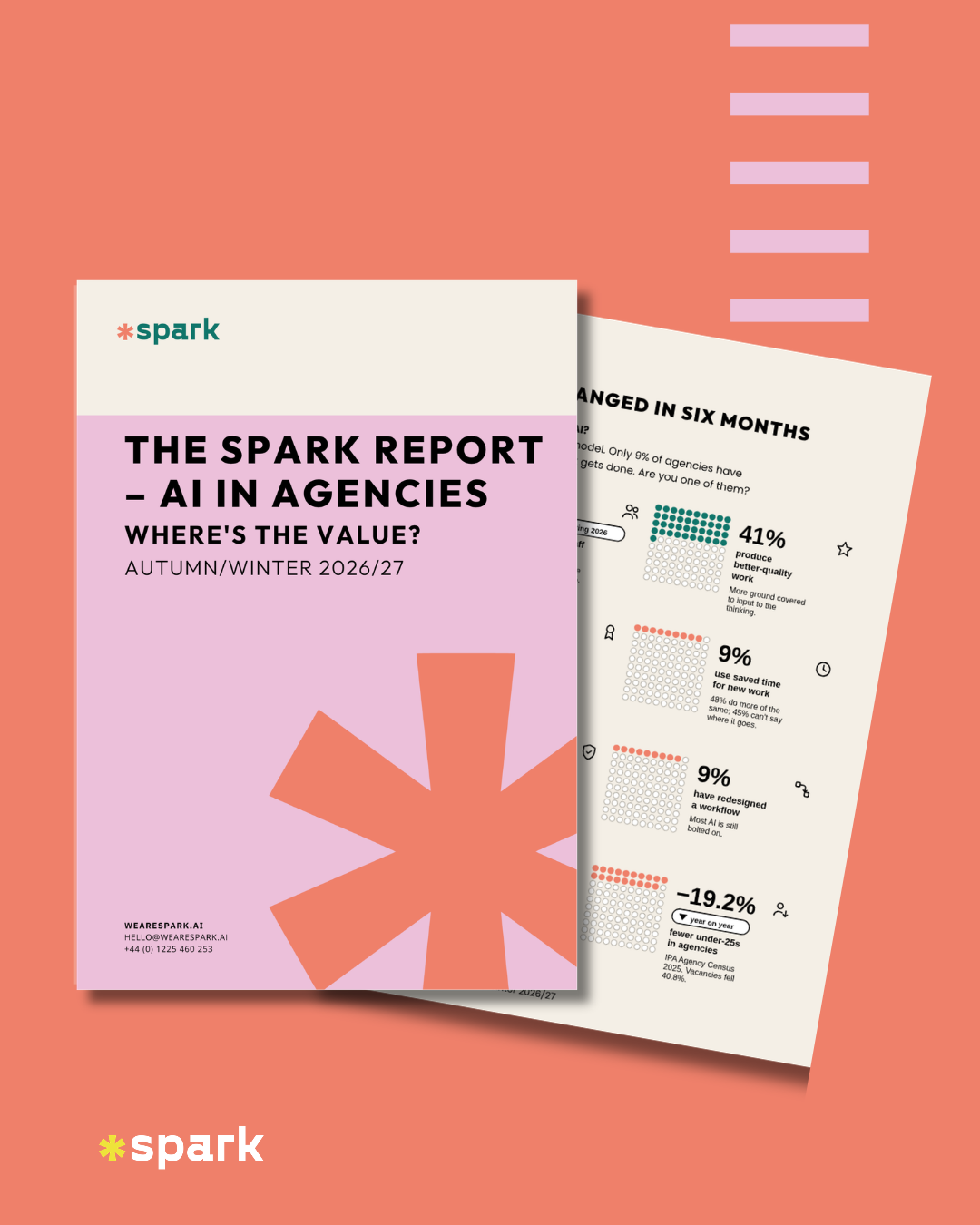
A major report into agency AI adoption has launched today, which reveals that just 9% of agency staff are turning time saved by AI into other kinds of work, and only 6% have developed new AI enabled revenue models. ‘The Spark Report – AI in Agencies: Where’s the Value?’ is the fourth edition of a six monthly benchmark from Spark AI. The report draws on over 350 qualitative and quantitative responses gathered from the company’s work with 2,500 agency professionals.
It reports that 90% of agency staff now use AI at work, and the share of those staff saving time with AI has doubled since 2025, from 45% to 91%. 13% of users save five or more hours a week, more than double the 2025 figure, while the proportion saving no time at all has fallen from 55% to 9%.
However, the time saved appears to be working for individuals, rather than the agency bottom line, and is rarely accounted for in the P&L. Teams reported many positive outcomes of AI adoption, for example 41% of respondents said time saved through AI goes into better-quality client work, while 25% said it reduces workload pressure. But 45% said the time saved is absorbed or hard to account for, and just 9% said it goes into new kinds of work.

“AI adoption is almost universal now in agencyland, but right now it’s one big leaky time bucket – most agencies just don’t know where all that saved time and increased productivity is going, which is a massive missed opportunity.” said Emma Wharton Love, Co-Founder and CEO of Spark AI.
“The truth is that saved time leaks unless you spend it on purpose. Agencies need a simple way of tracking time saved through AI, and a clear plan of what they want to do with it – which can be anything from making more money, to having more time for R&D and innovation, to simply giving your team members a better quality of life. It won’t just happen though, it needs to be planned for.”
Almost half (48%) of respondents said time saved through AI goes into producing more output in the same hours. But with 31% of agencies still pricing purely on time, faster delivery risks undermining their own business model.
According to Jules Love, co-founder of Spark AI, the biggest opportunity for AI in agencies comes from redesigning the way the work gets done. “If you charge by the hour and AI makes you faster, you earn less for the same work,” he said. “Right now clients are getting those gains for free. Agencies need to price the outcome rather than the time it took, and talk openly with clients about how they use AI.”
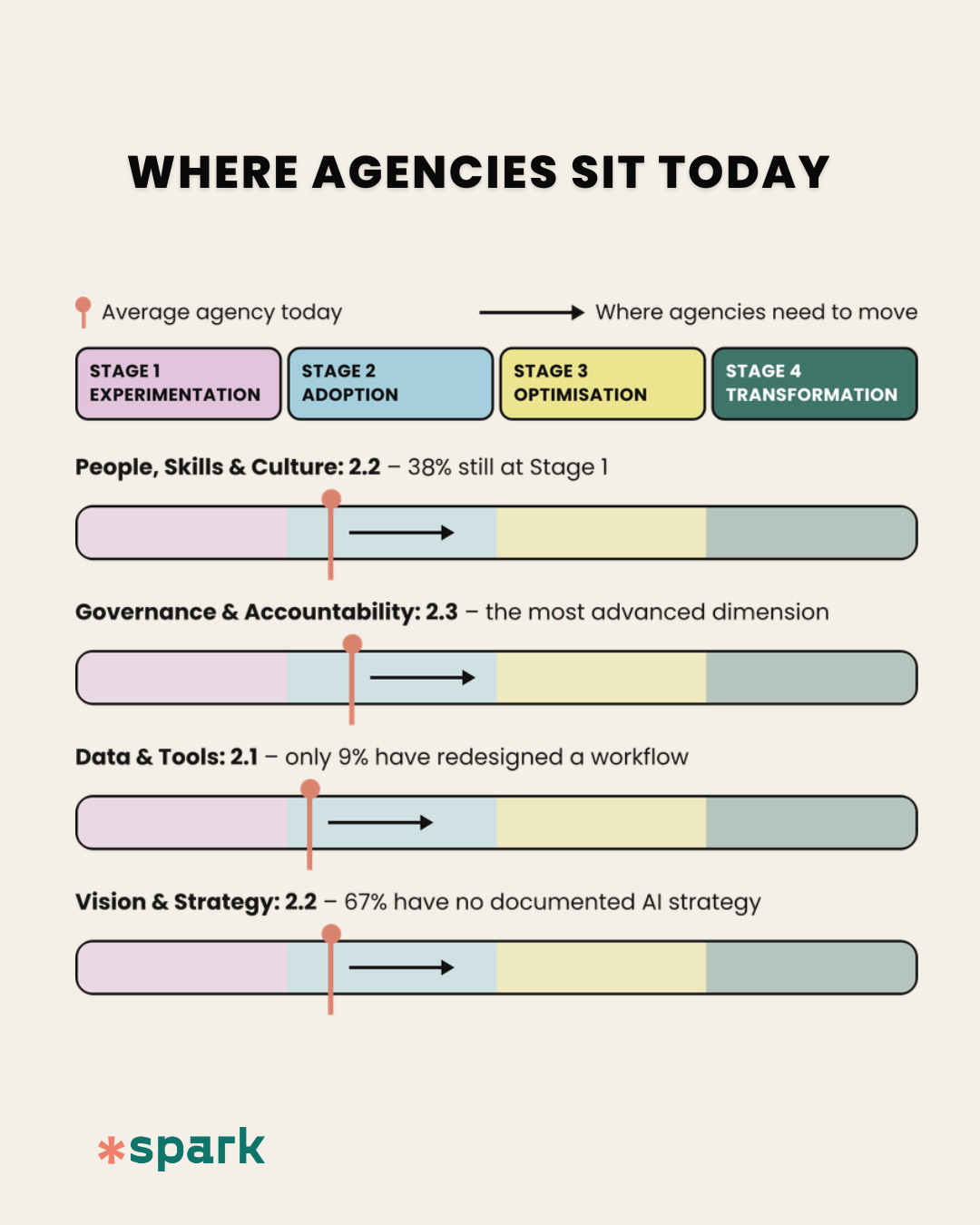
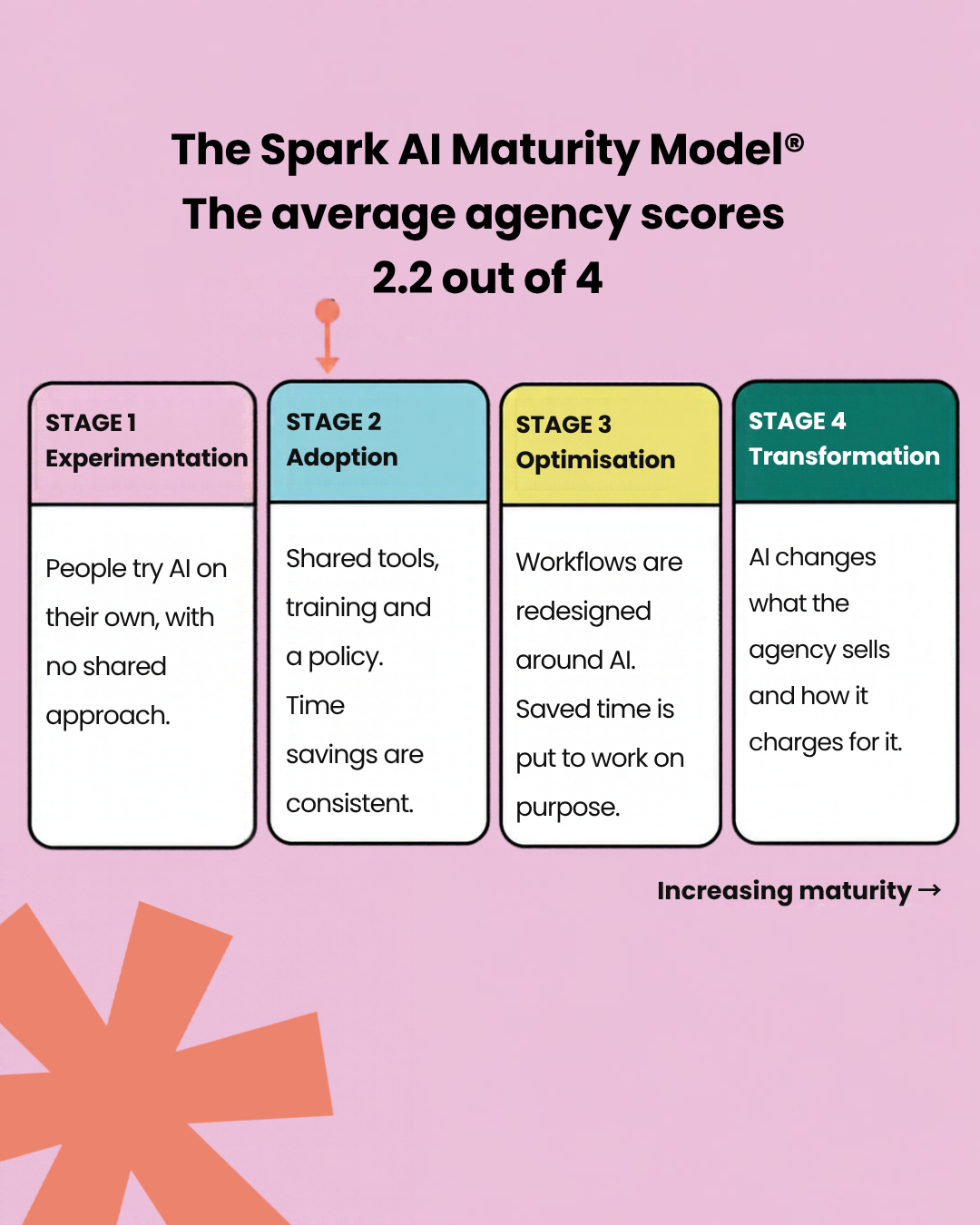
Most agencies have bolted AI onto their existing workflows, which speeds up individual steps but often simply moves the bottleneck to the next task in the chain. Redesigning work changes how the work gets done, opens up opportunities for services an agency couldn’t previously offer and creates something new to charge for. However, only 9% of agencies have redesigned a workflow end to end, giving clear roles for people and AI. Most (53%) use AI to improve existing processes, and 22% use it for office productivity tasks only, such as summarising documents and drafting emails.
Other key findings from the report:
Faster should cost more. 31% of agencies still price purely by time, so the faster AI makes them, the less they earn for the same work. 67% have no documented AI strategy, and only 6% have built a new AI-enabled revenue model.
Governance on paper, not in practice. 66% of agencies do not actively check how AI is used. 22% don’t monitor it at all, and 44% have a policy that nobody checks. More than half (55%) have no formal position on telling clients how AI is used in their work.
The junior pipeline is thinning. IPA data cited in the report shows employment of people aged 25 and under in agencies fell 19.2% in 2025, and the share of agencies employing graduates or apprentices dropped from 56% to 43%. The report argues that skills are the next advantage and that agencies need a new way for juniors to learn.
“The agencies front running agencies have written their expertise down, built it into shared assistants and agents, and given someone the job of making it stick. That’s the move from bolted on to built in, and it’s where the return starts to show,” concluded Emma Wharton Love.
The Spark Report – AI in Agencies: Where’s the Value? is free to download, with practical templates for every chapter and a 30-60-90 day AI plan.
Download at https://www.wearespark.ai/the-spark-report-ai-in-agencies-benchmark
Or see a preview at https://www.wearespark.ai/spark-report-preview password AW2026.
Source: Spark AI

AI productivity gains “leaking out” of UK agencies added by newsroom on
View all posts by newsroom →
You must be logged in to post a comment Login