BrainGroup Global’s “America In The Age of Uncertainty” study uses AI advanced reaction-time technology to expose the true depth of American ambivalence on politics, policy, and national identity
Americans say they have opinions. But do they really mean them? BrainGroup Global, a nonpartisan consumer and public sentiment research company, today announced the results of “America In The Age of Uncertainty,” a landmark study that goes beyond traditional polling to measure not just what Americans think, but how confident they are in their own opinions.
The nationally projectable findings on a sample of over 1300 Americans, addressing over 80 topical issues from how Americans feel about attacking other countries to using AI to teach their children, reveal a nation where sweeping uncertainty dominates on almost every major issue facing the US today. Uncertainty has become the defining condition of public opinion, cutting across political affiliation, age, and issue type.
“In a media environment with rapidly shifting narratives, the gap between what people say and what they truly believe has never been wider, or more consequential. We need to face the fact that the minds of many Americans are vulnerable to being moved, in almost any direction.” Elissa Moses, CEO of BrainGroup Global
Doubt In America’s Position
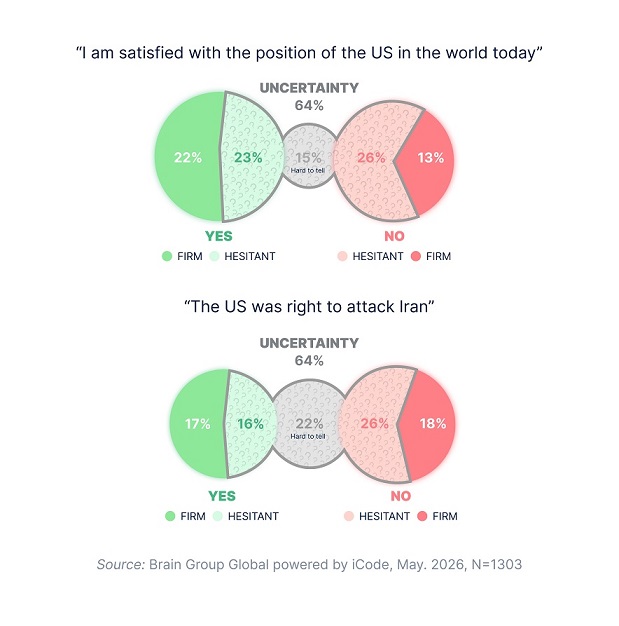
For example, the majority of Americans are uncertain about the position of America in the world today and whether or not we were right to attack Iran. Confidence in our policies, including several more in the study, are only around 20% or less.
On many major national issues, the majority of Americans lack firm conviction, regardless of how they answer survey questions.
Consider the statement: ‘I am satisfied with the position of the US in the world today.’ On the surface, 45% say yes and 40% say no – a near-even split. But when conviction is measured using reaction time based on Behavioral Science, only 22% convey a firm yes and just 13% a definite no. The remaining 64% of Americans may lean one way or another, but hold serious doubts.
This pattern repeats across a broad range of issues, from immigration and AI to foreign policy, gender rights, leadership, and national identity. Dozens of statements on these topics fall into what Moses terms the “zone of uncertainty,” where more than half of respondents – despite giving a yes or no answer – do so without conviction.
The divide is sharpest along party lines. Republicans and Democrats are highly polarized in their stated views, yet both groups exhibit significant ambivalence when conviction is measured. Notably, Independents currently skew closer to Democrats in their outlook. In general, Republicans are happier and more optimistic about the state of the country. Democrats express measured optimism and appear to be more worried for the future. This is further reinforced by comparisons to the same questions asked in an earlier poll in 2016 when Republicans expressed greater concerns for the state of the country. In essence, with new leadership, this divided nation has reversed itself with regard to satisfaction and optimism.
Where America Is Unified In Their Certainty
Does this mean that the country is uncertain about everything?
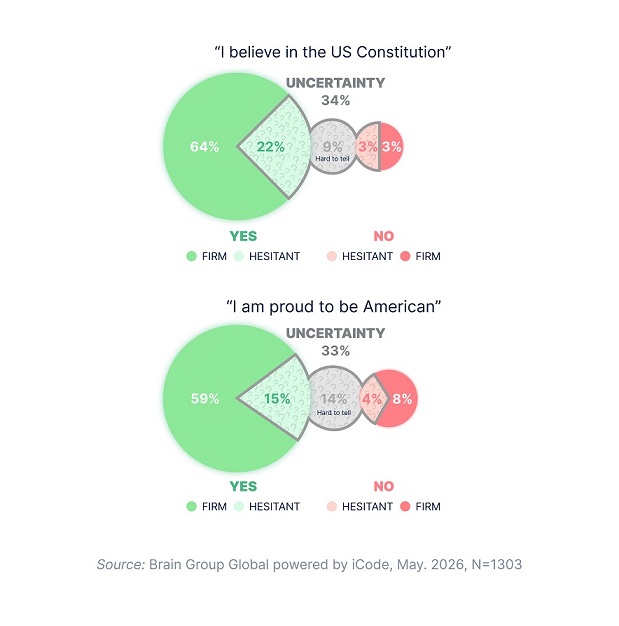
Amidst the wide fog of confusion and not knowing what to believe, Americans remain united on a few critical dimensions. Foremost is their belief in the United States Constitution. A vast majority of 85% say they believe in the Constitution and 64% are certain that they mean it. Additionally, most are proud to be American (74%) and 59% are firm, and in other data very content with their lives and their families.
America Is Also Highly Uncertain Regarding Entitlements and Fundamental American Values
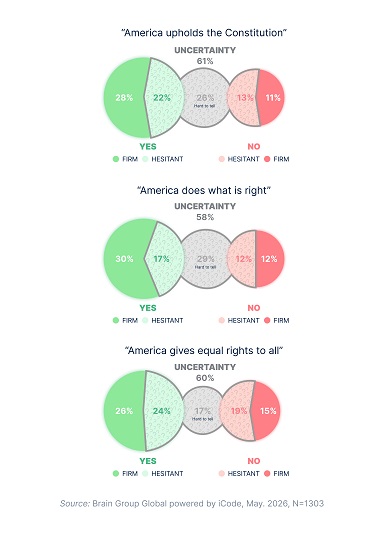
The study unexpectedly flags the long-term impact of declining civics education in America, pointing to high levels of ambivalence toward foundational statements such as “America upholds the Constitution” (as opposed to believing in it), “America gives equal rights to all,” and “America does what is right.”
“A landscape of low-conviction opinion carries serious implications for democratic participation, policy communication, and public trust. An uncertain public is a persuadable public, and this makes the quality of leadership, media, and civic education all the more critical.” Elissa Moses, CEO of BrainGroup Global
The study utilized iCode, an advanced technology platform created by Professor and Chairman Rafal Ohme, which uses reaction-time testing – a scientifically validated method rooted in mental chronometry – to assess the degree of hesitation behind survey responses. The core insight: the speed with which a person answers a question is a reliable indicator of their genuine conviction. A slow response signals doubt, ambivalence, or internal conflict, while a fast response expresses certainty and a higher probability of taking real-world action.
“The way we have been measuring public opinion for years is now enhanced by scientific discoveries and technological advancements. A ‘yes’ is not always a yes, and a ‘no’ is not always a no. By overlaying reaction-time data on top of traditional survey responses, we uncover a far more honest and actionable picture of where the American people actually stand. And, right now, most of them are standing in a ‘zone of uncertainty.’ Professor Rafal Ohme, Founder & Chairman of iCode
BrainGroup Global partners with iCode because its advanced reaction time research methodology represents a significant advance for all types of online survey questions used in polling, market research, and public policy analysis. By enabling us to differentiate conviction and uncertainty within answers, it offers a far more accurate and predictive lens on public sentiment than traditional survey methods alone.
Source: BrainGroup Global

New study reveals America is a nation in doubt: Most citizens are deeply uncertain about the issues that matter most added by newsroom on
View all posts by newsroom →
You must be logged in to post a comment Login