
What a movie from the 1990’s can teach us about strategy and the current moment we’re in
BY RG Logan – Chief Strategy Officer , StrawberryFrog
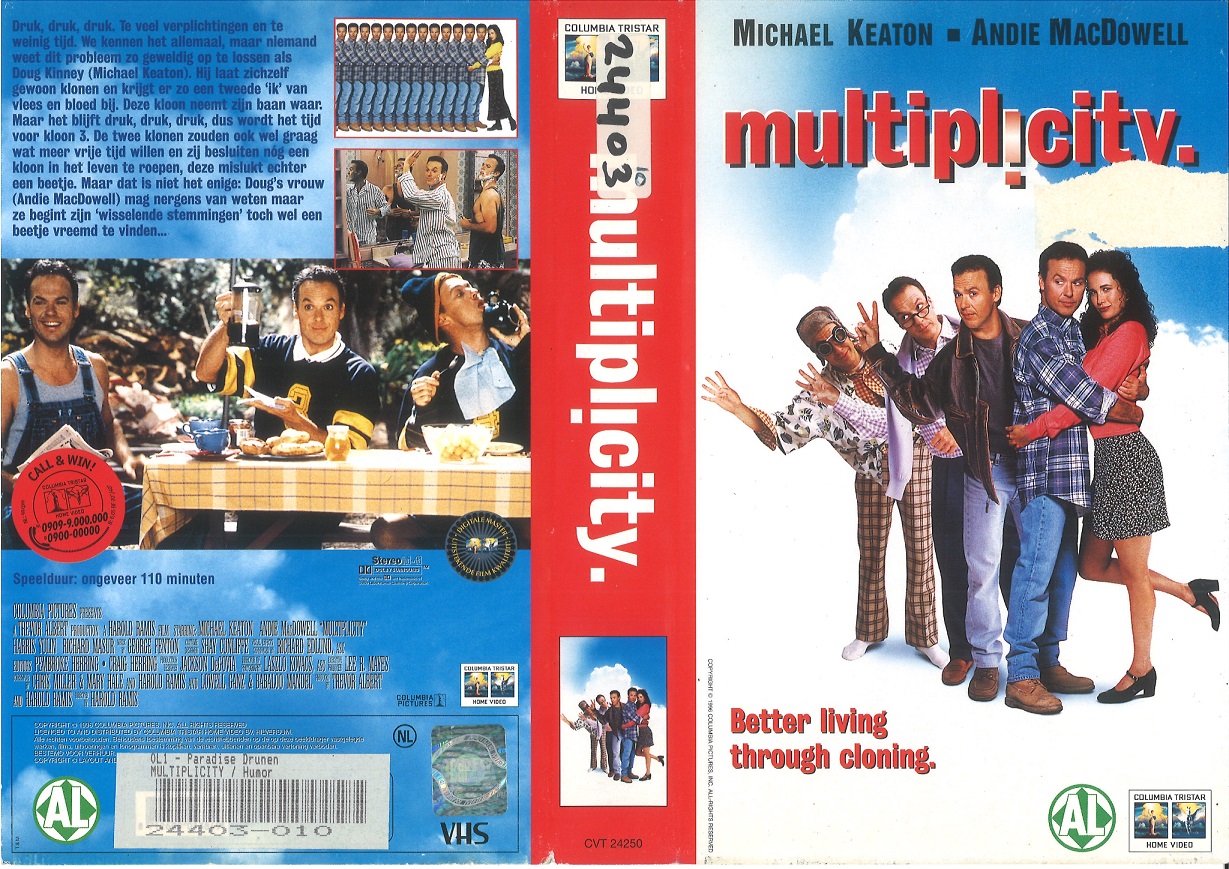
Michael Keaton is one of the greatest actors of all time. He’s been Batman, Birdman, and Beetlejuice. As a child of the 90s, I was fortunate to grow up in a house with a stack of well-worn VHS tapes. But there was one Michael Keaton movie in my collection that stood atop my Mt. Rushmore: Multiplicity.
You may be asking yourself what Michael Keaton has to do with advertising, or strategy. For those of you who’ve never had the pleasure of seeing this movie, please don’t let the 45% Rotten Tomatoes score scare you away. This 1996 comedic Frankenstein allegory has plenty to teach us about the moment we’re in.
The basic plot: Michael Keaton’s character, Doug, is a construction executive trying to balance the demands of work, life, and his relationship with his wife and kids. Doug meets a scientist working on a cloning device and decides to be his guinea pig. He clones himself in order to better handle his grueling work schedule, so that he can spend more time with his family. Of course, one clone is not enough, so he makes another, and another. Each version of Doug is a slight degradation of the original. There’s a line from one of the clones that becomes the thesis of the film: “you know how sometimes you make a copy of a copy, and it’s not quite as sharp as the original?”
Like many people in the advertising industry, I’ve gone through the various stages of grief brought on by the AI revolution we’re now living through. I’m happy to say I’ve come out the other side of acceptance. Not blind acceptance, though. That’s the key to not losing our minds, and to ensuring this industry continues to make the best work possible: strategically, creatively, executionally.
The first lesson Multiplicity has to teach us is about source material. At a basic level, AI is an input-to-output machine. As was true in the days before AI, the strategic process is a garbage in, garbage out system. The better the inputs, the closer to reality we are, the closer to the truth we get, the more we can connect the dots of specific knowledge with the general knowledge of our own life experiences, and the better the output will be.

Doug was solid source material. A good worker, a decent husband, present enough as a father. Clone an idiot and you get a gang of idiots. Clone a high performer and you get something workable, at least at first.
I am continuously impressed at how quickly AI can shortcut the insight process and get us smart on any topic. The right tools in the right hands can produce a desk research audit in an afternoon that would have taken me a week. But the early gathering phase, especially talking to real people, getting firsthand experience with our clients’ products and brands, reading articles and thought pieces, what Richard Huntington calls “scratching” in his book Feral Strategy, digging lots of holes and exploring adjacencies, cannot be replicated by AI.
The early parts of my strategic process look like chaos. I’m ingesting vast amounts of information from different sources, falling down rabbit holes that may not bear fruit. One thought sparks a memory of a study I read, a podcast I listened to, a movie quote that turns out to be the key to unlocking the insight. This associative, stream-of-consciousness thinking is something AI cannot yet replicate.
The imperfect weirdness of the human brain, which a computer might see as a bug, is our greatest feature.

The second lesson is about the degradation of thought that happens when AI feeds only on itself. The last Doug to be cloned, who prefers to go by the name Steve, is the main comic relief in the second act of Multiplicity. Steve is an adorable dimwit. While the first two Dougs were copied from the original Doug’s DNA, Steve was a copy of one of the clones. A copy of a copy.
If you’ve made it this far, you’re either a massive Michael Keaton fan or you’ve spent a good amount of time playing around with LLMs. If you fall into the latter, you’ve no doubt experienced the point of diminishing returns that comes from going back and forth with these models when you feel like you’re not getting what you want. Once the snake starts eating its own tail, it’s time to take a step back and feed it with fresh input. Practically, this usually means starting a new chat, going over some of the original inputs to see if I notice anything new in the data, and making my own connections rather than relying on AI to make those connections for me.

Even with the leaps being made in each model update, or the new AI-enabled tools that pop up every day (Granola may be my favorite), I am yet to find a replacement for thinking that is better than pen and paper. This article started as longhand in my Moleskine. Many creative briefs I write start the same way. When I need to think of something, I write and I write until a thought pops out. Most of it is trash, me talking to myself, but eventually a fresh thought appears. That fresh thought serves as new input into the system, enough to kickstart the machine.
Here’s a detail I only noticed on a recent rewatch. The cloning company in Multiplicity is called the Gemini Institute. In 1996 that was just a name, but in 2026 it’s the name of one of the leading AI models on the market, which feels like the kind of coincidence the universe sets up specifically to make essayists smug.


But there’s something to it. The film’s whole argument is that the clones are only as good as the original, and each generation away from the source loses something essential. That’s the part the industry keeps trying to wave away. We talk about AI as a productivity multiplier, a force equalizer, a way for smaller shops like StrawberryFrog to punch above their weight. All true. What gets less airtime is the obvious corollary: the multiplier only works if there’s something worth multiplying.
The fundamentals of strategy haven’t changed. Discovery, insight, a clear problem, a clear way forward. AI doesn’t replace any of that. It just makes the gap between strategists with a real point of view and strategists who are competent operators much, much wider. The people who win in this era are going to be the ones who are worth cloning in the first place.
Everyone else is making Steve.
BY RG Logan – Chief Strategy Officer , StrawberryFrog

How to Use AI for Strategy Without Losing Your Mind added by newsroom on
View all posts by newsroom →
You must be logged in to post a comment Login