
Prophet’s latest consumer AI report finds usage up 50% but two-thirds worry about the human impact
One great irony of the AI boom is the more people rely on it, the more they are beginning to distrust it.
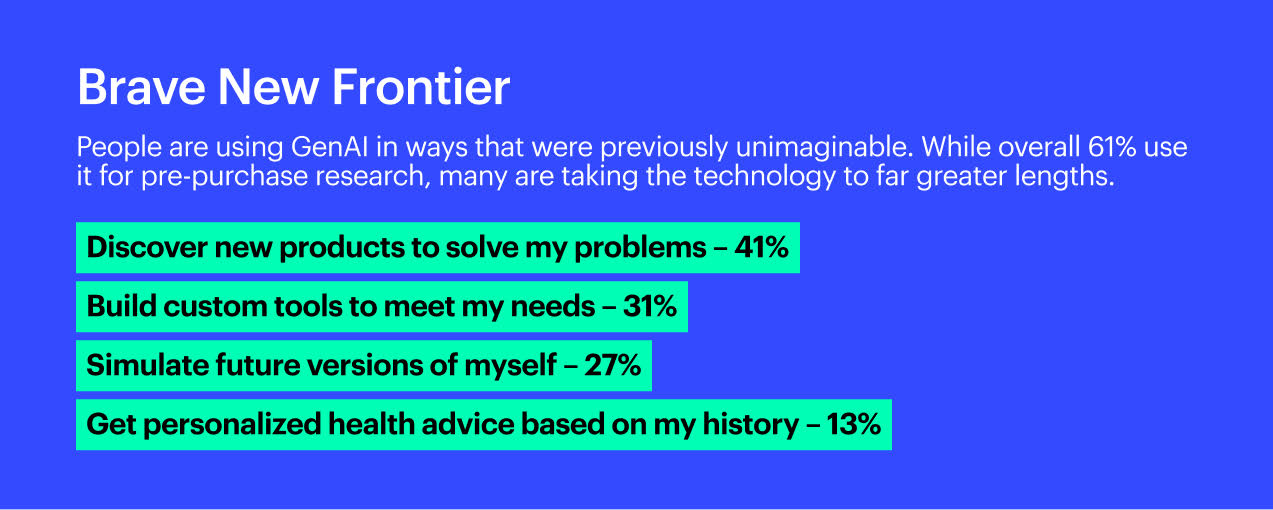
According to a survey of over 2,000 consumers in five countries by growth firm Prophet, global consumer use of generative AI has increased more than 50% in the past two years, from 45% in early 2024 to 73% in 2026. What began as experimentation is now routine behavior, with people turning to AI for decisions that carry real personal weight.
Yet roughly two-thirds of AI users are concerned about the effects: specifically, that AI inaccuracies could influence world events while eroding logical skills and human connection. That raises the bar for business leaders.
Embracing autonomous agents:
Many users have moved well beyond “prompting” towards more sophisticated and personalized AI use cases. More than a quarter of users (27%) report using AI to simulate future versions of themselves and testing how different purchase decisions might play out over time. Another 13% say they are sharing personal medical information with AI systems in exchange for tailored health guidance.
Sixty-six percent of people say they want systems that can interpret intent and context without requiring carefully written prompts. As they experience more fluid interactions elsewhere, writing instructions, refining inputs, and managing outputs starts to feel like work. They want platforms that anticipate needs, recognize patterns, and respond with minimal friction. The direction mirrors changes already underway in enterprise environments, where more adaptive systems are replacing rigid input structures.
Top 5 agentic capabilities users want:
- Discount monitoring and automatic purchasing: Monitor favorite brands and automate purchases when they’re on discount (60%)
- Proactive customer service prevention: Proactively manage products and services to prevent issues or breakdowns (54%)
- Experience coordination: Coordinates experiences across multiple brands used (54%)
(e.g., automatically rerouting a dinner reservation as a result of a flight delay) - Needs-based purchasing: Automate purchases based on personal preferences (53%)
- Offer negotiation: Negotiates pricing and terms on the consumer’s behalf (49%)
“Users are signalling AI should meet them where they are, without requiring them to adapt their behavior to a tool,” said Chan Suh, Chief Digital Officer at Prophet. “As generative AI becomes more embedded in everyday decision-making, the next phase will be defined less by access and more by experience, including how naturally these systems fit into people’s lives, and how much trust they can earn along the way.”
Ironically, trust is getting harder to maintain as adoption rises.
AI users are now weighing convenience against control, and speed against trust. Overall excitement about GenAI has dropped approximately 7% since Prophet’s 2024 study. More significantly, 30% fewer users believe that they will come to rely on GenAI for most of their daily decisions. That signals a meaningful shift in consumer psychology.
- 71% of consumers worry that inaccurate AI outputs could influence decisions in the real world.
- 63% are concerned that relying too heavily on AI may erode human skills.
- 61% say they fear a loss of human connection as AI becomes more embedded in daily life.
“As consumers continue to increase their reliance on AI to support their lives, businesses will need to redirect AI investments from efficiency to innovation that provides emotional benefits, not just utility,” said Chiaki Nishino, President at Prophet. “The next wave will be defined by systems that don’t just complete tasks, but create meaning, delivering experiences that feel intuitive, human, and emotionally resonant. That’s where real differentiation happens.”
Methodology
For its new The AI-Powered Consumer report (download link here), Prophet surveyed more than 2,000 consumers in China, Germany, Singapore, UK and the US in January and February of this year. All respondents were 18 years of age or older and had used at least one AI tool for personal reasons during the prior six months.
Source: Prophet

Personal AI Adoption Rises Sharply, But So Does Concern added by newsroom on
View all posts by newsroom →
You must be logged in to post a comment Login